
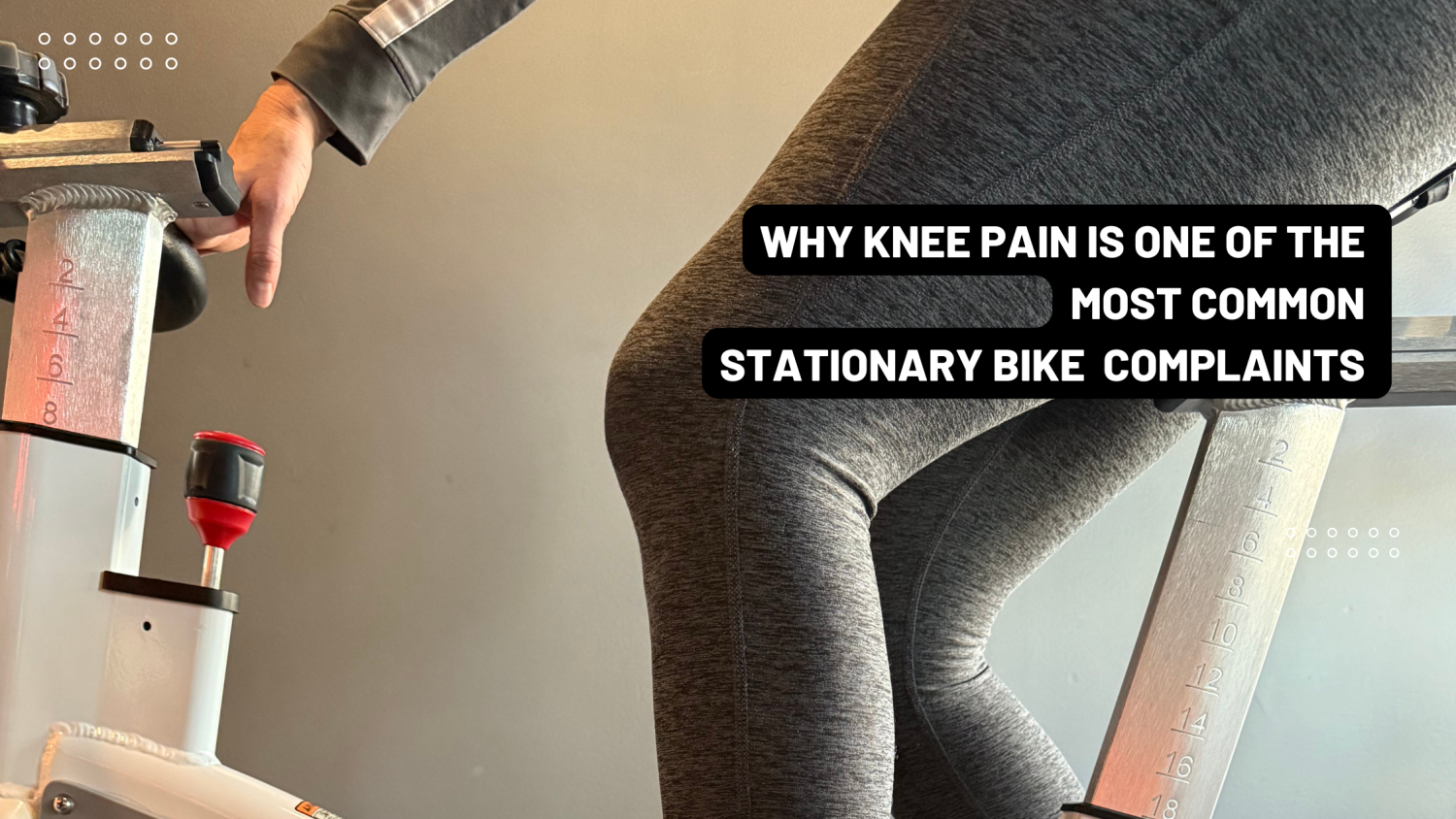
Why knee pain is one of the most common stationary bike complaints
Knee pain is one of the first issues people experience when riding a stationary bike, especially if they’re new to cycling or returning after time away. What’s important to understand is that this discomfort is rarely caused by weakness, poor fitness, or “doing it wrong.” More often, it’s a mechanical issue caused by how the stationary bike is set up in relation to your body.
Because cycling is a repetitive motion, even a small misalignment can be magnified over hundreds or thousands of pedal strokes. The knee, which sits between the hip and the ankle, tends to absorb the consequences of those misalignments very quickly.
How seat height directly affects knee mechanics
Seat height determines how much the knee bends and straightens during each pedal stroke. When this height is off, the knee is forced to work outside of its optimal range of motion.
At the bottom of the pedal stroke, the knee should still have a slight bend. This allows the muscles of the legs to share the workload evenly while protecting the joint from excessive compression or strain.
When the knee is asked to bend too much or straighten too far, discomfort often follows.
What happens when the seat is too low
A seat that is set too low keeps the knee in a deeply bent position throughout the pedal cycle. This increases pressure at the front of the knee joint, particularly around the patellar tendon and kneecap.
Riders in this position often feel:
– pressure or aching at the front of the knee
– fatigue in the quads very quickly
– a sense that pedaling feels “heavy” even at low resistance
Over time, this excessive bend can irritate the knee because the joint never gets a chance to move through a more natural, efficient range.
What happens when the seat is too high
A seat that is too high creates the opposite problem. Instead of too much bend, the rider is forced to reach for the pedals at the bottom of the stroke.
This often leads to:
– subtle hip rocking side to side
– uneven pressure through the legs
– pulling or strain behind the knee
Because the body is trying to compensate for the lack of reach, the knee can be stressed with every pedal stroke, even if the discomfort isn’t felt immediately.
Why hip movement matters for knee health
The knee does not operate independently. When the hips are unstable or shifting, the knee is forced to manage forces it wasn’t designed to handle.
Hip rocking, which commonly occurs with a seat that’s too high, pulls on the knee from slightly different angles on every rotation. Over time, this can create irritation that feels confusing because the pain shows up at the knee, even though the problem originates higher up.
What proper seat height should feel like
In a well-adjusted position, pedaling feels smooth and controlled. The legs extend naturally without locking, and the hips remain relatively steady on the saddle.
You should feel like:
– you’re pressing the pedals, not reaching for them
– the movement is fluid rather than choppy
– pressure through the knees feels even and predictable
If something feels strained, forced, or unstable, it’s often a sign that the seat height needs adjustment.
Why setup matters more than resistance or intensity
Many riders assume knee pain means they need to ride less, lower the resistance, or build more strength. While rest and conditioning matter, they won’t fix a mechanical mismatch between your body and the bike.
Correcting seat height and overall bike setup often resolves knee discomfort far more effectively than changing workout intensity or your overall cardio exercises. Getting the foundation right allows the joints to move the way they’re designed to, making cycling feel supportive rather than punishing.
For most riders, revisiting basic stationary bike setup is the most impactful first step toward pain-free riding.

